Developing carbon management at scale is one of the most pressing and complex challenges for Europe’s path to climate neutrality. For energy-intensive and hard-to-abate industries such as cement, chemicals, lime and waste, carbon capture, utilisation and storage (CCUS) will be indispensable to address process emissions that cannot otherwise be eliminated. At the same time, these technologies raise substantial questions of infrastructure, finance, regulation and cross-border cooperation that must be resolved if carbon management is to become a viable pillar of Europe’s decarbonisation strategy.
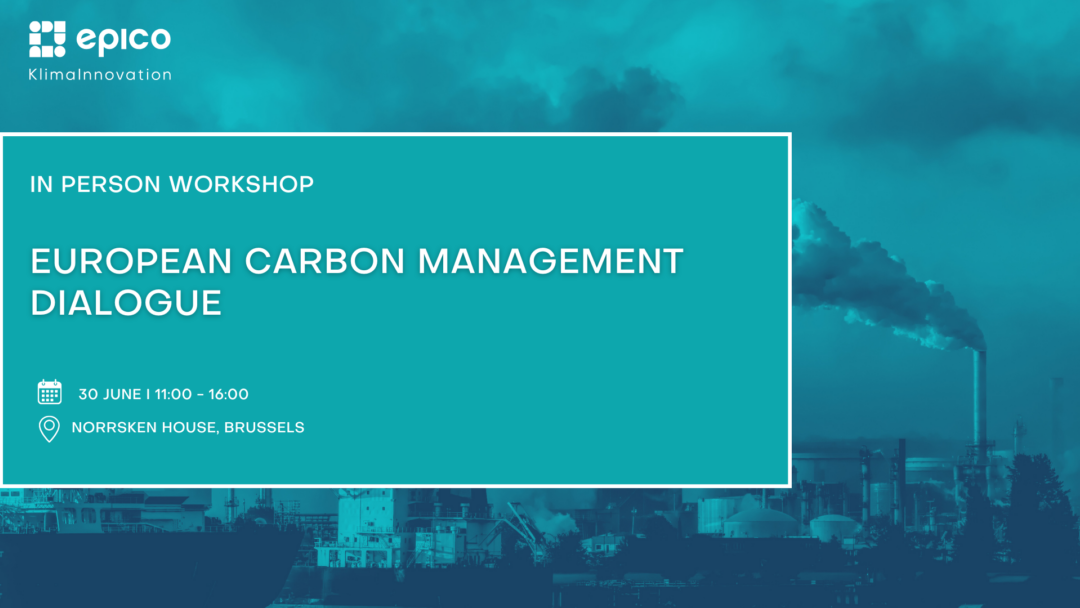
Against this backdrop, EPICO convened around twenty representatives from governments, EU institutions, industry, and leading think tanks at our Brussels office for the European Carbon Management Dialogue. The discussions centred on three key themes: national strategies in Northern Europe, the EU’s policy framework and cross-border cooperation, and industry perspectives on scaling CCS and CCU.
Participants highlighted the need for fully-fledged national carbon management strategies that go beyond capture technology itself, encompassing integrated CO₂ transport, offshore storage capacity, and supportive business models. While Norway and the UK are advancing rapidly with offshore storage development, several EU countries continue to face strong public resistance to onshore storage. Ensuring access to offshore storage across borders will require early investment in CO₂ transport infrastructure and coordinated policy action to enable a functioning, integrated market.
The debate also underscored the urgency of building a coherent EU framework that reduces fragmentation and provides long-term certainty for investors. Current EU instruments, including the ETS, do not yet provide a sufficient business case to offset the high upfront costs of carbon capture projects. The Clean Industrial Deal is therefore expected to play a pivotal role, not only in filling regulatory gaps around cross-border CO₂ transport and storage, but also in creating demand for low-carbon industrial products and ensuring that competitiveness concerns are properly addressed.
Industry stakeholders emphasised that carbon management solutions must reflect sectoral realities. For some industries, CCS will be the only viable route to address process emissions; for others, CCU may enable innovative business models such as synthetic fuels or CO₂-based feedstocks. The consensus was clear: CCS and CCU should not be developed in isolation but as part of an integrated carbon management ecosystem, including shared capture hubs, coordinated deployment, and active involvement of oil and gas companies in storage infrastructure.
By combining technical, policy and industrial perspectives, the European Carbon Management Dialogue provided a platform for structured and solutions-oriented exchanges. The conclusion from this discussion will feed into an upcoming Policy Report, which will offer concrete recommendations to European and national decision-makers on building a harmonised, competitive and climate-resilient carbon management framework for Europe.